

01Start with the first-level tutorial
Coffee Jam moves coffee trays through a crowded board toward the conveyor. Follow the original first-level tutorial before trying to solve the layout by trial and error. It shows how the game connects a tray movement with the conveyor.
Normal and Nightmare are different challenges. Choose the mode in the native menu, and use its own level selection to return to a stage. The website’s full-page and fullscreen controls enlarge the running game; they do not select another mode.
02Read a rectangle, rather than one cup
A tray moves as a complete rectangle. When you inspect a gap, compare it with the whole tray, including the far edge. A space that appears open next to one cup may still be blocked elsewhere along the rectangle.
Before dragging a large tray, trace the intended route. Identify the neighboring tray that occupies the route and consider whether a smaller tray can be moved first. This turns an apparent dead end into an ordered sequence of moves.
03Check the matching color before committing
The conveyor and matching cups matter as well as open space. Look at the next matching color before committing a large tray. An open route is useful when it also brings the right tray toward the right destination.
Avoid treating every movement as progress. A move may create room for a later tray even if it does not immediately clear the board. Compare the space before and after it, and keep the useful route available for the next step.
04Review a blocked position
When a tray will not move as expected, check the full route again and compare the entire rectangle with the available space. Read any native tutorial or help instruction that applies to the current stage.
The portal keeps the supplied game’s rules and menu intact. Its embedded, full-page, and fullscreen views use the same live game. Try enlarging the view when tray edges are difficult to distinguish, and use the game’s original controls for restarting or choosing a level.
- Check the whole tray footprint.
- Clear a small obstruction before a large move.
- Read the matching color before dragging.
05Match the whole order, not only the drink
The native help requires both the drink color and the full order size. A three-cup order needs a three-cup tray. If a two-cup tray reaches the intake and does not serve, check the order instead of assuming the drag control has failed.
Any top cup slot can touch the blue intake. Keep that serving edge in mind while clearing the route: the tray needs a useful orientation and an accessible path to the intake, not merely an empty square somewhere nearby.
06An opening you can reason through
Suppose the next order needs a large tray but a smaller tray occupies its route. First find an empty position that can hold the whole smaller tray without blocking the intake. Move it there, recheck the larger tray’s footprint, then approach the intake with the matching order size. This describes a planning pattern rather than a fixed level solution.
In Normal, a full tray leaves and creates room. Reinspect that new space before the next move. With keyboard controls, select a tray, move with the arrow keys and press Enter to fill it beneath the intake.
- Read color and cup count.
- Open a route for the entire tray.
- Recheck the board after the full tray leaves.
07Level 1: read the four-cup order
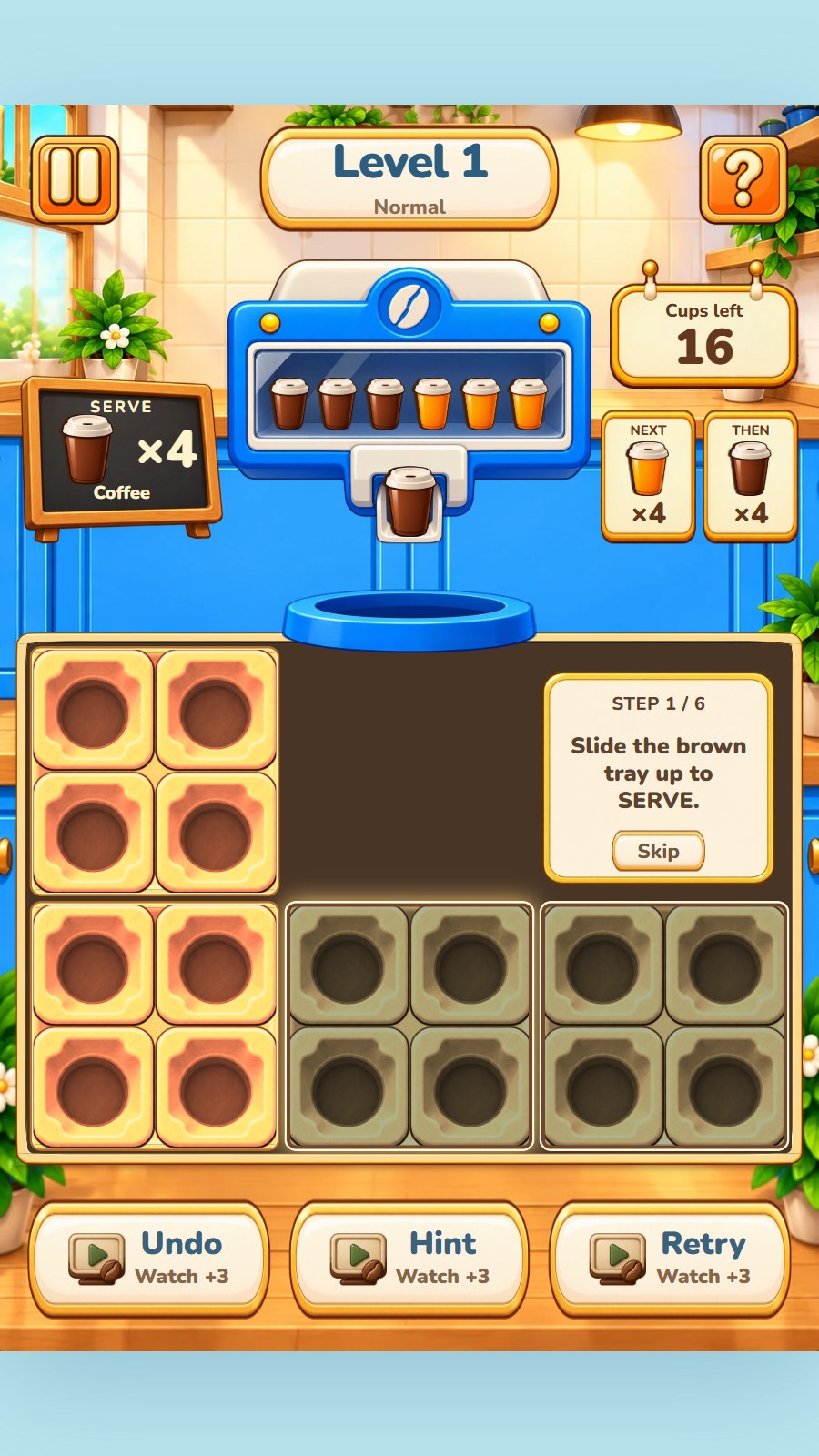
In this captured Normal Level 1, Cups left starts at 16 and the current SERVE order is Coffee ×4. The tutorial highlights a brown tray and asks you to slide it upward. Compare the tray’s entire four-slot footprint with the path to the intake before dragging.
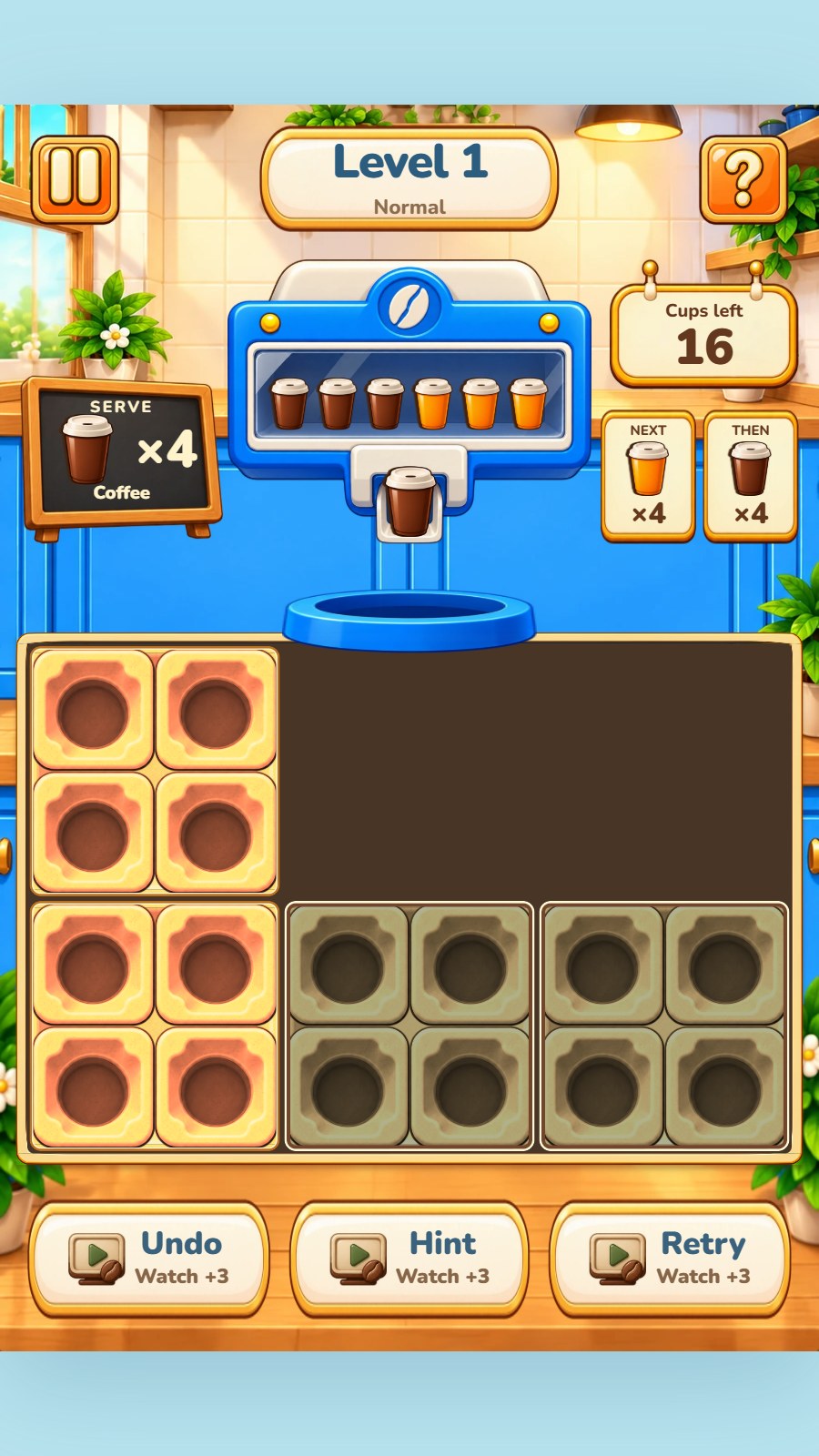
The second image shows the same opening after Skip closes the tutorial; no cup has been served between these two images. Use the order panel and the full tray together: an open route alone does not settle which tray can fulfill the current order.

 Play now Coffee Jam